a conversation with:Cheryl Greenberg

A Spacious Self-Interest

Revisiting Troubling the Waters 20 Years On

Twenty years after her groundbreaking book, historian Cheryl Greenberg revisits the rise and strain of the Black-Jewish coalition, and what it can teach us now.

This is an edited version of the first of Cheryl Greenberg’s two New Lehrhaus talks on Black-Jewish relations, given on November 11, 2026. Greenberg is the Paul E. Raether Distinguished Professor of History Emerita at Trinity College and the author of Troubling the Waters: Black-Jewish Relations in the American Century (Princeton, 2006). Her remarks have been condensed and lightly edited for reading. The discussion that followed is not included.

Why look back now

I rewrote the introduction to this talk about seventeen times, because when I was first invited to give it, we were in a very different moment. We had the protests over Israel and Gaza. Then came the midterm elections, an amazing set of elections as far as I’m concerned. Now the question I keep coming back to is how we restore the values we care about (democracy, decency, equality) to the country.

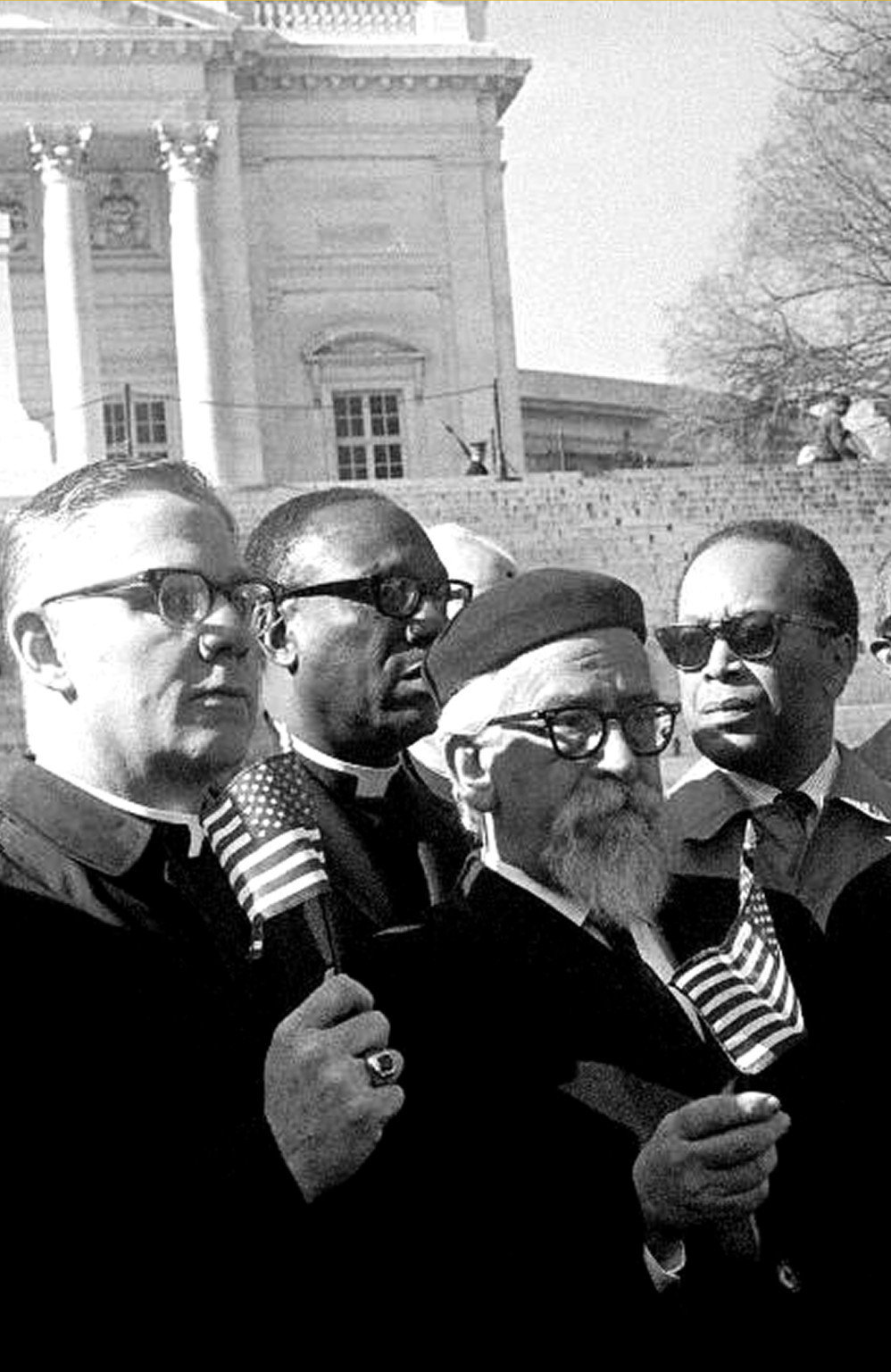
If Jews want to be part of that struggle, we have to understand our role in previous civil rights efforts, because our part in them was so central. So I don’t see this as history so much as political science. I can’t help myself, though; I’m a historian, and it will certainly be history.

Being past an election doesn’t mean we aren’t still in a mess. I don’t need to lay out what we’re struggling against: open white Christian nationalist and anti-feminist rhetoric, the violation of civil liberties, xenophobia, the degradation of civic life, the replacement of compassion with cruelty. And Black-Jewish relations, which I think are so crucial to meeting those threats, were in a mess even before October 7. We have been witnessing divisions within both communities as strong as those between them. So simply unpacking the history of Black-Jewish relations won’t cut it.

Tonight I want to look at the development of what we call the Black-Jewish coalition (some call it the Black-Jewish alliance), but through a slightly different lens than I took in the book. I want to pay closer attention to the internal political divisions in both communities, which I’ll label liberal and leftist, even though it is obviously much more complicated than that. Next time, I’ll turn to some of the terms we use without much reflection, like antisemitism, whiteness and Zionism, and pick up the story from Black Lives Matter through Trump, Charlottesville and the debates over Israel and Palestine.

Why look at the history of a coalition between African Americans and Jewish Americans to imagine a future effort with so many more players and so many cross-cutting, even contradictory, agendas? I’m going to argue that we have to, not because that original coalition was smooth, but precisely because it wasn’t, and it was still incredibly effective. Its successes can teach us about organizing across lines of race, class, gender and religion. Its failures can warn us of the pitfalls.

So here are my central arguments. First, the Black-Jewish coalition, and the broader liberal and progressive coalition it was part of, won victories in civil rights, civil liberties and economic justice while fighting internally. There was never not tension. But by holding to their broader goals, people who disagreed were able to move forward together.

Second, the coalition was weakened not just by class and racial differences, but by the divergent political understandings those differences produced. Most of all, it was weakened by the liberal goal of race blindness, and by the invisibility of white privilege to Jews who didn’t see themselves as entirely white. We have to be mindful of those dangers going forward.

There was never not tension. But by holding to their broader goals, people who disagreed were able to move forward together.

A word on terms. When I say Jews here, as most people who write about this do, I mean Jews of European descent. There are, of course, Jews of color, many of whom have themselves been part of the struggle. But the presumption that all American Jews were white, and the fact that white Jews historically ran all the powerful Jewish organizations, allowed too many of those Jews to take their whiteness for granted. Ironically, it even allowed them to deny that they were white, and so to miss their own racial privilege in the United States. That, as we’ll see, became one of the stumbling blocks of the coalition.

A bond that had to be built

There has long been a bond between the Black and Jewish communities, and not only among leaders, as some have argued. Think of Jews for Obama or the Obama campaign’s Jewish outreach; there were no Swedes for Obama, and no Methodist outreach. Nor was the feeling only on the Jewish side, as others have claimed. The NAACP has protested swastikas and antisemitic incidents. Black churches have long supported Israel, and they rallied in Pittsburgh after the synagogue shooting there. As I recently learned, Martin Luther King’s birthday is also National Bagel Day. Who knew?

But the bond is not something inherent in our two peoples, natural or inevitable. As a product of Jewish Sunday school, I’m sorry to say that it is not rooted in Jewish ethics. There were no Jews in the leadership of the abolitionist movement. The one Southern rabbi who spoke against slavery was run out of town by his own congregation. Most Jewish civil rights activists were Reform or secular Jews, not Orthodox.

Nor was there anything special about being an oppressed minority. So were the Irish, and so were the Japanese. They generally didn’t make common cause with other outsiders; more often they embraced whiteness so as to be integrated into the mainstream more quickly.

What I want to claim instead is that something happened to move African Americans and white Jews toward each other. I find that heartening. It means communities, like individuals, have real choices to make, and that there is no such thing as political predestination. So what created that bond, and why did it come apart? What worked, and what should we be careful not to do again?

Communities, like individuals, have real choices to make. There is no such thing as political predestination.

Shared experiences, separate organizations

The two communities have had very different histories, but around the turn of the twentieth century they shared some experiences. Both moved to cities: two million Jews came from Eastern Europe and Russia, and more than a million African Americans moved north in a migration so massive we call it the Great Migration. Both faced exclusion from jobs, neighborhoods and schools. Both faced hatred and violence. Racism was always more virulent in the United States, but each could erupt into lethal violence, as the lynching of Leo Frank showed.

Like many other communities, both built organizations to help themselves. On the Black side came the National Association of Colored Women in 1896, the NAACP in 1909, the National Urban League in 1911 and the National Council of Negro Women in 1935. Their Jewish counterparts included the National Council of Jewish Women in 1893, the American Jewish Committee in 1906, the Anti-Defamation League in 1913, the American Jewish Congress in 1917 and the Jewish Labor Committee in 1934. In both communities, I should add, women led the way, as they did through the whole civil rights movement. That is a story for another time.

Both groups sought equal opportunity and full inclusion in American life, but virtually no white organization was willing to work with Black groups to achieve it. The exception was the left, which was deliberately interracial from the start because its focus was class. Many East European Jews had been trade unionists or Bundists before they came, and they brought their socialist and communist ideas to industrial centers like New York and Chicago. The first American Bund convention met in 1906, and the Jewish Socialist Federation formed in 1912. The Amalgamated, the International Ladies’ Garment Workers’ Union and the Cigar Makers were all Jewish-organized or Jewish-led, and they were the only unions that accepted Black members.

Meanwhile, some Black migrants had been chased from the South for organizing sharecroppers in integrated groups like the Southern Tenant Farmers Union. In the North they saw exploitative working conditions and the power of collective action, and they became radicalized. By the 1930s, the three largest ethnic groups in the New York Communist Party were African Americans, Jews and, oddly, Finns. They committed themselves to racial equality as part of uniting the whole working class against bosses who tried to divide it with bigotry. Most famously, they defended the Scottsboro Boys, nine young Black men falsely accused in 1931 of assaulting white women in Alabama.

From early in the century, communists, socialists and Workmen’s Circle chapters in New York, Pittsburgh, Chicago and elsewhere boycotted racist and antisemitic shows and movies, protested housing discrimination, and organized Black and Jewish industrial workers, in Yiddish as well as English, for fair wages and better conditions. Virtually every tactic of the civil rights movement (sit-ins, mass demonstrations, picket lines) was pioneered by these same communists and socialists. I’d argue that even the notion of a Black-Jewish coalition is a product of the left. Leftists saw the link between racism and antisemitism much sooner than liberals did, and given their focus on class, they called not for cooperation but for unity. As James Ford, a Harlem Communist Party leader, put it:

The Negro masses in active struggle against antisemitism. The Jewish masses in active struggle for Negro rights. Only this will deprive reaction of its ace trump.
James Ford

Not every Jew in these early struggles was a leftist. Some Jews and African Americans we might now call liberal, though they were radical for their time, also worked together. A disproportionate number of the NAACP’s white founders were Jewish. Julius Rosenwald of Sears, Roebuck built hundreds of schools for Black children in the South and supported many Black artists. W.E.B. Du Bois wrote against antisemitism. Black and Jewish intellectuals challenged the assimilationist rhetoric of “100% Americanism” and argued instead for pluralism: every group has its own culture and traditions to celebrate, and that is no threat, because underneath we share the same basic values.

But most immigrant Jews outside the left, like other whites and like the German Jews who had come before them, hesitated to involve themselves in African American struggles. As one Anti-Defamation League leader reasoned, “The difficulties facing the Jews as a minority group are sad enough without tying ourselves up with another minority group of less influence, and by so doing, probably taking on some of their troubles. A group whose difficulties, in my estimation, are even more deplorable than our own.” Most white and other minority groups felt the same, and they continued to stand apart.

The 1930s turn: a spacious self-interest

What moved these Jews was the rise of Nazism and fascism in the 1930s, at home and in Europe. Jewish groups reached out to African Americans for help with rallies against racism; there are photographs of W.E.B. Du Bois and Stephen Wise together. African Americans, in turn, linked Nazism abroad to anti-Black racism at home, as in the Double V campaign for victory abroad and victory at home. After Kristallnacht, the NAACP telegrammed the State Department: “American Negroes share the indignation at the outrages of the Nazi government. But we would be even more enthusiastic if our government could be equally indignant at the lynching of American citizens by American mobs, which have shamed America for a much longer time.”

This was self-interest on both sides, and over the next two decades it broadened into active collaboration on a wide range of civil rights issues. Why then? For the same reason most crimes succeed: motive and opportunity. Jews feared that calling attention to antisemitism would give it a wider platform, so they pushed instead for broad anti-discrimination laws. Nazism, and really the whole of Jewish history, taught them that when anyone was threatened, the Jews would be next. For African American leaders, Jews seemed a powerful, well-organized ally they could persuasively appeal to, particularly given the Nazi threat.

Notice that this is not the leftists’ argument. Communists and socialists held that racism and antisemitism were tools capitalists used to oppress all workers, so fighting racism served their single goal. The liberal view posited parallel self-interests between groups. Still, it marked the start of a coalition that stretched from the left through the liberal center, which in both communities was where most people stood.

To make the collaboration work for liberals, Black and Jewish leaders emphasized the two groups’ common plight and shared suffering. “We Jews know what restrictions mean,” read one Anti-Defamation League flyer. “We, too, have faced handicaps. Because of this, Jews show such deep interest in the Negro problems.” The left had set the stage: the Yiddish press had long covered lynch mobs and called them pogroms, and leftist Black newspapers covered the worsening situation of German Jews.

So what launched widespread collaboration by the late 1930s wasn’t a broader challenge to discrimination, but the decision to fight it together. That was a pivotal shift. Both communities had redefined their self-interest to include the concerns of others, what I call a spacious self-interest. That means more than seeing lynching and pogroms as similar forms of oppression. It means recognizing the links between them and restating your own agenda in more universal terms: the cause isn’t just about Black people or about Jews, but about all Americans, because only by attacking every form of bigotry can any group be safe.

Only by attacking every form of bigotry can any group be safe.

And it worked. In 1938, a Black Baptist church raised money for Jewish refugees, writing, “As a race of people whose souls have been made sensitive through many years of persecution and suffering, we extend our profoundest sympathies to the Jewish people in their present plight.” A wartime study in Detroit found that Black people expected more of Jews than of other whites because they were fellow victims, and Jews felt the same way. In New York, amid many complaints about the exploitation of Black domestic workers, only Jews responded, setting up an employment center where workers could meet employers and get fair contracts.

But notice who was doing the hiring. Stressing similarity and shared suffering masked crucial racial and class differences between the two communities. That would lead to misunderstanding, resentment and paternalism, and later help erode the coalition.

One short but important aside: all of this happened over the protests of many Southern Jews. They had absorbed local racial views, and they feared, rightly, that speaking up would provoke antisemitism. Most kept quiet, and they begged their Northern counterparts to be quiet too. That is another story; with many exceptions, I am largely speaking here of Northern Jews.

Cold War liberalism and its victories

American politics was changing too. During the war, a new public rhetoric insisted that the war effort demanded unity, and news of genocide in Europe led the country to emphasize tolerance and pluralism, at least rhetorically. Then came the Cold War. Overt American discrimination was the best propaganda the Soviet Union had for winning nonwhite, nonaligned nations to its side. At the same time, intensified anti-communism at home led communists and socialists to tone down their rhetoric and blend in with liberals, while nudging them toward greater activism.

The result was a newly shaped liberalism that understood rights as rooted in individuals rather than groups. It sought access to jobs, housing, voting and civic life, free of discrimination based on group membership. It was consciously pluralist, and it focused on individual action rather than structural change, because structural change sounded too much like communism. Since we are all the same under the skin, the thinking went, we need only change our hearts and the rest will follow.

That activist liberalism both spurred and shaped Black-Jewish coalition building, locally and nationally, among leaders and at the grassroots. Where segregation ruled by law, they challenged the law. Where discrimination violated the law, they took discriminators to court. They proposed civil rights planks for both parties’ platforms and testified before Congress on civil rights, civil liberties and social welfare legislation. They organized petitions, letter-writing campaigns and joint lobbying. And they produced educational materials for schools, churches and civic groups stressing pluralism and tolerance, on the assumption that more united Americans than divided them and that changing beliefs and behavior was the key to equality. Discrimination, in this view, was a matter of personal bigotry, not of protecting white privilege.

This spacious, universal statement of liberal values carried both communities well beyond direct self-interest. Segregation laws did not affect Jews, but all the major Jewish organizations filed briefs in Brown v. Board of Education and dozens of earlier, lesser-known cases. The NAACP, for its part, fought for higher immigration quotas for Jewish refugees, and it lobbied the Haitian, Liberian and Filipino delegations at the United Nations to support the creation of Israel, though with hesitations about what would happen to Palestinians. Liberal Black and Jewish groups also defended leftists whose protests against racism in Northern cities provoked a racist backlash that police then blamed on the protesters.

The successes were notable. Black and Jewish agencies and their allies desegregated hospitals, schools, housing projects, unions, bowling leagues, restaurants, beaches, and medical and legal associations. Local coalitions passed anti-discrimination and anti-KKK laws in dozens of cities. They integrated workplaces, challenged the poll tax and fought segregated housing. In Hollywood, a Black and Jewish group challenged racial and ethnic stereotyping. In New York, a joint effort helped create the State University of New York to counter racial and religious discrimination at private colleges. Together they opened social and economic opportunity, extended educational and legal equality, and expanded the social safety net.

What liberalism couldn’t see

Even as all this was happening, powerful tensions ran between the two communities, because most Black and Jewish Americans remained divided by race, religion and class. Those divisions shaped people’s attitudes in real but unrecognized ways. Liberalism largely ignored class and race and tempered its demands, since talking about them sounded suspiciously like communism. By focusing on personal bias, it missed how racism was embedded in the very structures of society. Theoretical race blindness was not enough.

Racial discrimination had trapped African Americans, North and South, in low-wage, low-mobility work, and that was a structural problem. East European Jews had also started at the bottom here. But although similarly poor, they had come from cities, often with skills that most Black rural workers lacked. And as white people, they had access to institutions and opportunities closed to people with darker skin. Those advantages, plus good timing, helped them rise despite antisemitism. Most Jews committed to individualist liberalism didn’t recognize the role structural racism played in limiting Black progress, and the leftists who might have pointed it out had been silenced by anti-communism.

Here is one example. Jews, more successful economically and white, which of course are related, often worked in Black neighborhoods, partly because they were less racist than other whites. So Jews became the landlords, teachers, social workers and store owners, and Black residents became their clients. No one looked at this as a class issue; that was communist talk. Jews saw themselves as open and tolerant, having risen through their own hard work, and as benevolent benefactors. They certainly didn’t see themselves as white. Whites had persecuted them in Europe.

But Black people did see Jews as white, and Jews did have economic advantages that came with whiteness, even if they didn’t see it. Because Jews were present in Black neighborhoods, Black residents saw them not as fellow outsiders but as insiders exploiting outsiders, and they protested. Jews saw the protests as antisemitism. Black residents saw rich whites exploiting poor people shut out of opportunities whites enjoyed. Those conflicting perspectives bred resentment on both sides.

The blindness to structural racism could also produce a quid pro quo expectation, and paternalism, on the part of the more powerful Jewish partners. During the 1947 debates over the partition of Palestine, Walter White of the NAACP complained about Jewish leaders who “ought to know better” treating the Haitian, Liberian, Indian and Filipino delegates with “obvious condescension bordering on contempt because of their color and status.” Resentments like that surfaced repeatedly over the years, never derailing the coalition, but often troubling it. Racial and class differences still divided most Black and Jewish people, and by and large that went unacknowledged and unaddressed.

Theoretical race blindness was not enough.

Despite those tensions, and despite Jews’ rising economic status, liberal and progressive Jewish groups kept working with Black colleagues well into the 1960s. That included the tactics the left had pioneered, like demonstrations, marches and lobbying, and the hardest and most dangerous organizing work. Andrew Goodman, Michael Schwerner and James Chaney were murdered at the start of Freedom Summer in Mississippi in 1964; Goodman and Schwerner were Jewish, and Chaney was African American. The two heads of the Leadership Conference on Civil Rights were Roy Wilkins of the NAACP and Arnold Aronson of the National Jewish Community Relations Advisory Council.

The rupture of the late 1960s

But the liberal consensus was fraying around them, and liberal and leftist action came apart once again. Moderate groups pressed leftists to tone down their tactics, demands and rhetoric. They insisted, for example, that SNCC, the Student Nonviolent Coordinating Committee, remove the militant language from its speech at the March on Washington so as not to alienate the president and the liberal legislators needed to pass civil rights laws.

By the mid-1960s, to many on the left, especially the young, liberalism seemed to have failed the movement, and in egregious ways. There were no federal protections for people engaged in legal activity like registering to vote. Attacks on civil rights activists went unpunished. At the 1964 Democratic National Convention, that supposedly liberal party refused to seat the integrated Mississippi Freedom Democratic Party, which had grown out of Freedom Summer, in place of a delegation chosen in an illegal all-white primary. And Martin Luther King Jr. was attacked in Chicago, the bastion of Northern liberalism.

Those disappointments fueled Black nationalism and Black Power on the Black left. SNCC and CORE became all-Black, and the Black Panthers rose. You cannot trust white liberals, they argued, because when forced to choose between their whiteness and their liberalism, as at the 1964 convention, they chose whiteness. They also criticized liberalism’s commitment to integration as both unachievable and a kind of cultural genocide, since racism would supposedly end only when Black people acted like white people.

More subtly (and this is more my own theory), the left’s understanding of racism shifted, and with it the sense of who Black people’s natural allies were. The older view had linked hatred of Black people and of Jews as products of the same pseudoscience, the biological falsehood that certain peoples were inferior. The New Left concluded instead that racism grew out of capitalism and state power. That tied together the experiences of people of color around the world and focused attention on institutional racism and on European colonialism. So the left split. Black Power activists turned away from treating racism and antisemitism as linked and toward alliance with other people of color worldwide.

Many white Jews and most white organizations, liberal rather than leftist, fundamentally misunderstood the frustration and anger behind these moves. They saw them not just as tactical errors but as an unfair, even racist or antisemitic, rejection of their efforts: nationalism and separatism felt like a wound to the heart. Many progressive Jews, on the other hand, celebrated Black nationalism and modeled their own activism on it, calling it Jewish power. Turning to their own community as the Panthers had, they fought for Soviet Jewry and for Jewish studies programs alongside the Black studies programs Black students were demanding. They kept the leftist arguments, but moved away from a coalition built around racism and traditional civil rights.

In 1967, SNCC criticized Israel’s treatment of Palestinians as part of a global struggle of people of color against colonialism. Leftist Jews understood. Liberal and mainstream Jews saw antisemitism and withdrew their support. Had they understood the anger and frustration behind it, and the shifting focus on European powers oppressing indigenous peoples of color, they could still have disagreed without taking it as a personal attack. Instead, they demanded that SNCC defer to Jewish concerns before they would help with its civil rights struggle, and reminded Black leaders of all that Jews had done for them. SNCC’s statement, Harry Golden wrote, “comes with ill grace from an organization from which two Jewish boys were murdered while doing field work for SNCC.” Jewish financial support for SNCC plummeted.

Refusing to aid SNCC because of its support for Palestinians again shows the effects of invisible white privilege. Without realizing it, Jewish groups saw themselves more as benefactors than as partners. If they didn’t get their way, they would withdraw support from the cause SNCC represented.

Without realizing it, Jewish groups saw themselves more as benefactors than as partners.

Meanwhile, liberal Jews were rethinking their own commitments, and not only over Israel. As the civil rights movement moved north into their own neighborhoods, integration took on a different meaning. With their concerns framed in terms of class rather than race, most white Jews fled cities for suburbs almost as quickly as white Christians did, to escape what they saw as the decline of their schools and neighborhoods as municipal services declined along with the white population.

That flight followed lines drawn decades earlier. The federal redlining maps of the 1930s, including those for Oakland and Berkeley, graded neighborhoods by who lived in them, and the grades determined who could get a mortgage. One top-rated district earned its grade partly because “deed restrictions prohibit Asiatics and Negroes.” Another was marked down “because of the presence of two Negro families and the threat of further infiltration.” Neighborhoods were carved up structurally: Black families could buy only in certain areas, and white families found it hard to get mortgages there even if they wanted to. In the new suburbs, William Levitt, himself Jewish, excluded Black buyers from Levittown.

Worried about what they saw as the extremism of leftist protesters, Jewish leaders urged patience and moderation on Black colleagues: change was coming, things were working themselves out. Liberal Black leaders, themselves skeptical of the new radicalism, had defended Israel and their Jewish partners and tempered their own protests. They read those calls for patience as evidence that Jews could no longer be relied on as allies.

That wasn’t really true. Most white Jews still believed in a liberalism focused on individuals rather than groups. Their blindness to the benefits of white skin let them believe they had risen on their own merits and that Black people could do the same if they kept at it. It was on precisely those divergent political understandings that the collaboration foundered.

Diverging paths

The divergence was visible in moments of direct confrontation. In 1968, the conflict over community control of schools in Ocean Hill-Brownsville, in Brooklyn, pitted a largely Black community against a largely Jewish teachers’ union, and many saw it as an explicitly Black-Jewish fight. In the affirmative action cases of the 1970s, Black organizations filed briefs in favor and most Jewish groups filed in opposition. It was the first time Black and Jewish organizations had publicly taken opposite sides in a civil rights case.

For Jews, affirmative action violated the race-blind, individualist liberalism they still believed in; explicitly considering group membership, they insisted, was the antithesis of liberalism. For Black Americans, it was crucial to closing the gap between the rhetoric of race blindness and the reality of continuing discrimination and institutionalized racism. We have seen that argument play out again recently, as the Supreme Court has dismantled the Voting Rights Act. By not recognizing the structures of opportunity under white supremacy that they themselves had benefited from, Jews failed to challenge them, and in that sense failed their civil rights colleagues.

You can only argue for color blindness if you’re blind to your own color privilege.

Other conflicts turned uglier: the Crown Heights riot of 1991, and many public expressions of antisemitism by Black figures, Louis Farrakhan and the Nation of Islam above all. But it wasn’t only political differences or violence that weakened cooperation. The Jewish community itself had changed. It was now middle and upper class and largely suburban, and Jews and their agencies turned their attention away from poverty and urban problems. Some went further. Neoconservatives argued that liberalism had degenerated into favoritism, social disorganization and a nanny state. If Black nationalists had challenged liberalism from one side, a Jewish turn toward conservatism and parochialism challenged it from the other. That mutual distrust also fed what we now call identity politics, which narrowed what each group defined as its own interests and concerns.

Meanwhile, the gap between Black and white incomes and life chances, which had begun to shrink in the 1960s, widened again. A white backlash swept Richard Nixon, then Ronald Reagan, then Donald Trump into office, and each time reversed recent progress on school and residential desegregation and weakened civil rights laws and remedies. Each time, public discourse returned to a familiar and chillingly racist rhetoric of us versus them. It cast African Americans outside the boundaries of American society, joined after 9/11 by Muslims and now also by immigrants, feminists, queer people and Jews. Too often, as we know, that rhetoric has turned to violence.

By the 1980s, Black and Jewish Americans saw themselves as facing very different problems, and liberalism, especially the fractured liberalism that emerged from the chaos of the 1960s and ’70s, seemed either unable to solve them or discredited altogether. Even on the left, conversations stayed inside each community rather than building coalitions for larger goals. And that is usually where the story ends.

Liberalism did not die

But I want to argue that liberalism did not die, and that most Black and Jewish Americans were, and still are, motivated by liberal and progressive values. All along, most Jews still looked like traditional liberals: in their lower levels of racism, their continued commitment to civil rights, their views on social issues and certainly their image of themselves. What changed was that Black and Jewish Americans no longer saw themselves as sharing priorities, and both had largely traded the rhetoric of universalism for self-assertion. It is no surprise that the partnership withered.

Even in those years, though, liberal political cooperation never stopped. The media just didn’t cover it, because it wasn’t sensational. Black and Jewish groups continued, and continue, to defend aid to public education, anti-poverty programs, anti-discrimination laws, voting rights, women’s rights and gender equality, and lately to protect those gains from being stripped away. They continue to challenge outbursts of religious and racial hatred and violence, at home and abroad. In the more recent affirmative action cases, most Jewish groups filed briefs in favor; more Jews had come to see the conflict between race-blind theory and existing structures of inequality. That, by the way, is critical race theory in a nutshell.

Both communities, in other words, remained invested in the politics that underlay the civil rights coalition, and both have reasserted the importance of working together, even in Crown Heights. Since before Trump emerged, there has been striking new energy in both communities to tackle broad social problems, from voting rights to LGBTQ equality and from ongoing discrimination to civic engagement, and to do it in coalition.

Liberalism did not die. Most Black and Jewish Americans were, and still are, motivated by liberal and progressive values.

Next time, I’ll turn to the limits that coalition has run into, starting with Black Lives Matter and the question of Jews and whiteness, and then turning to antisemitism and Zionism, and to where Black and Jewish Americans see their interests coming together, or not.

Part 2

Cheryl Greenberg’s second session takes up the coalition from Black Lives Matter to the present.

Join us for the course

Revisiting Troubling the Waters 20 Years On

November 116 – 7:30 pm (Pacific)

makeityours

Membership puts you at the center of what we do

  • 01⅔ OFF ALL PROGRAMS
  • 02ON-DEMAND LEARNING WITH OUR VIDEO LIBRARY
  • 03ADVANCE NOTICE FOR ALL SPECIAL EVENTS
Support us