Event Series:
View All Programs In This Series
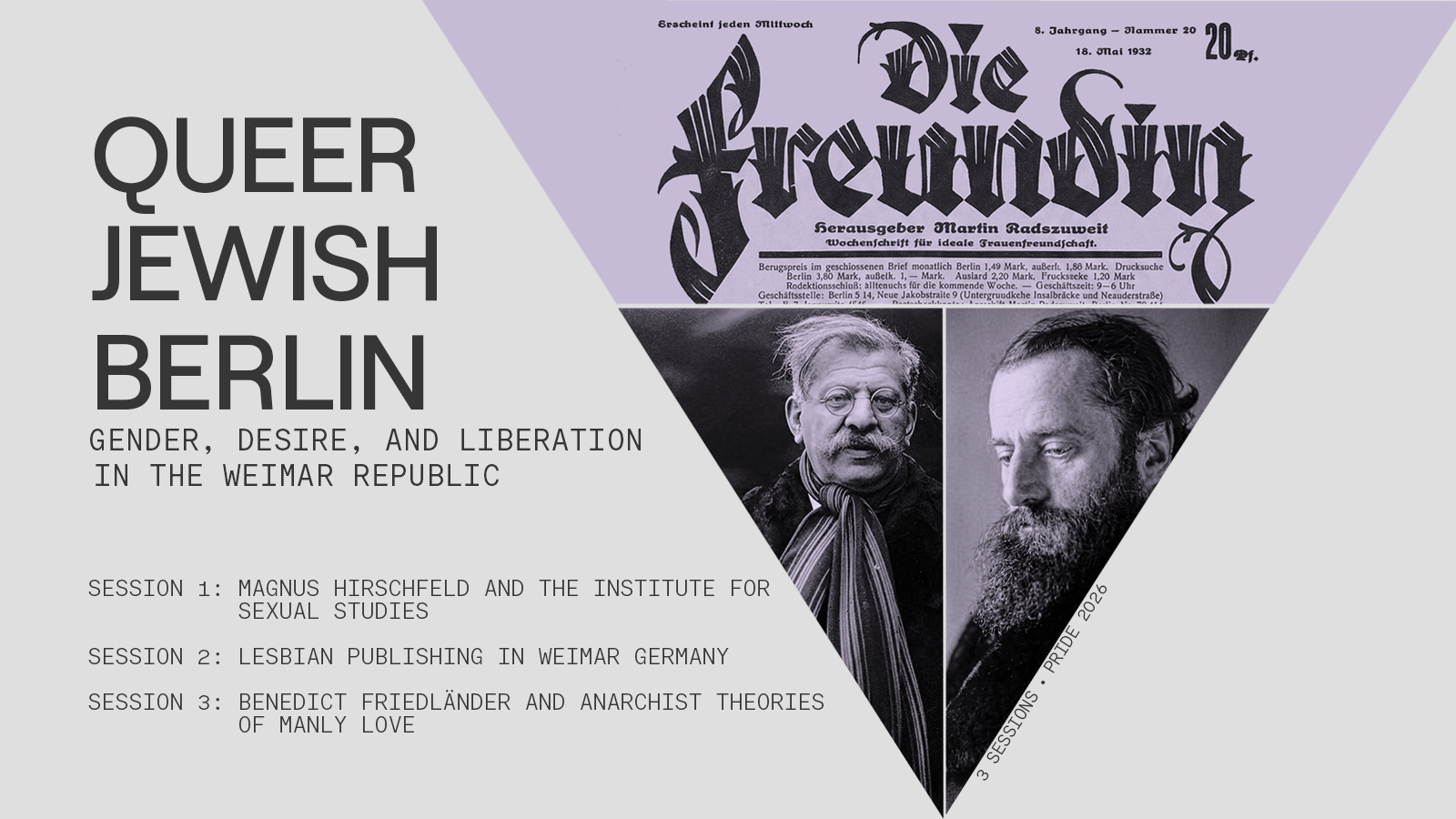
Queer Jewish Berlin: Gender, Desire, and Liberation in the Weimar Republic
Course Summary for Search and Accessibility
This course, Queer Jewish Berlin: Gender, Desire, and Liberation in the Weimar Republic, is an Educational Program offered by New Lehrhaus. It is scheduled to begin on 6/2/2026 and conclude on 6/16/2026. The sessions are held weekly on Tuesdays from 6:30pm to 8:30pm Pacific.
The total registration fee is $54.00. The course is conducted Online via Zoom and focuses on Magnus Hirschfeld, Benedict Friedlaender, and Lesbian Publishing in Weimar Germany.
This course has been postponed. Please check back for updates.
When Franz Rosenzweig opened the original Lehrhaus in Frankfurt in 1920, a parallel revolution was already underway in Berlin. Jewish doctors, publishers, and anarchist philosophers were building the world's first institutions dedicated to what we now call LGBTQ+ rights—writing foundational texts on gender identity, filling newsstands with the world's first lesbian magazines, and theorizing forms of love and community that defied every convention of bourgeois life. Their work was as intellectually profound as anything produced at the Frankfurt Lehrhaus.
This three-session reading circle recovers that world. We'll read primary texts alongside contemporary scholarship to explore three distinct currents of radical queer Jewish thought in Weimar Germany.
Session I (June 2) — Magnus Hirschfeld, the Institute for Sexual Studies, and the Scientific-Humanitarian Committee
Magnus Hirschfeld (1868–1935), a gay Jewish physician, founded the world's first LGBTQ+ advocacy organization in 1897 and opened the Institut für Sexualwissenschaft in Berlin in 1919: performing some of the world's first gender-affirming surgeries and issuing early identity documents to protect trans people. His concept of sexuelle Zwischenstufen (sexual intermediaries) anticipated modern ideas about nonbinary and genderqueer identity. We examine his writings and ask: what does it mean to argue for liberation through science?
Session II (June 9) — Die Freundin, Frauenliebe, and Garçonne: Lesbian Publishing in Weimar Germany
Between 1924 and 1933, Berlin's newsstands carried the world's first lesbian magazines—publications that created community across a dispersed readership, debated the nature of lesbian identity, published queer fiction, and navigated an uneasy relationship with the male-dominated homosexual rights movement. We read from the magazines themselves and ask: how does a community build itself through media when it barely has a name?
Session III (June 16) — Benedict Friedlaender and Anarchist Theories of Manly Love
Where Hirschfeld sought reform through science and parliamentary coalition-building, Friedlaender (1866–1908), a Jewish sexologist, economist, and anarchist, drew on Max Stirner and Nietzsche to imagine something more radical: a Gemeinschaft der Eigenen (Community of the Queer) that rejected state law, medical categorization, and mainstream politics alike. We read his 1904 manifesto and ask what his debate on masculinity with Hirschfeld illuminates about contemporary tensions between assimilationist and transformative approaches to queer liberation.
All readings are provided in English translation. No prior knowledge of German, Weimar history, or Jewish studies is required.
Who this is for: Anyone curious about LGBTQ+ history, Jewish intellectual history, the Weimar Republic, or the deep roots of contemporary debates about gender identity and queer liberation.
What you'll leave with: Fluency with the foundational figures and texts of the modern LGBTQ+ rights movement; a richer understanding of Weimar Jewish intellectual life; and new frameworks for thinking about the relationship between science, community, and liberation.
Three Tuesdays: June 2, 9, and 16, 2026 at 6:30–8:30pm Pacific